Driving Change Behind the Wheel: How RSAI's Public Institution Drivers Training Project Is Paving the Road to Safer Government Transport in Liberia
In its first phase, RSAI trained and certified 250 drivers from four government ministries, turning a concept into a tested model for institutional road safety.

- 2024Phase I launched
- 4Ministries in Phase I
- 250Drivers trained and certified
- 3 daysPer training workshop
In a country where road traffic fatalities outpace most global averages, road safety is no longer optional. It is urgent. According to the World Health Organization, road crashes claim more than 1.19 million lives a year, and while Africa has only 3% of the world's vehicles, it suffers over 20% of global road traffic deaths. Liberia's situation is even more serious, with an estimated 35.9 fatalities per 100,000 people, among the highest in the world.
Poor enforcement of traffic laws, deteriorating road infrastructure and the absence of standardized driver training have long been cited as causes. One factor is often overlooked: the conduct of public institution drivers, the people behind the wheel of vehicles that transport government officials, critical documents and, in some cases, vulnerable populations.
A new model for public sector road safety
Road Safety Action International (RSAI) has taken Liberia's alarming road safety statistics and turned them into a call for national action. Through its Public Institution Drivers (PID) Training Project, RSAI is rolling out a practical solution: train the drivers at the heart of government mobility.
Launched in 2024, the first phase of the PID Project set out to train drivers from four key ministries:
- MPWMinistry of Public Works
- MOHMinistry of Health
- MOEMinistry of Education
- MOAMinistry of Agriculture
By the end of Phase I, RSAI had trained and certified 250 government-employed drivers, turning a conceptual initiative into a proven, scalable model for institutional road safety reform.
Why public institution drivers?
Public institution drivers are not just vehicle operators. They are mobile representatives of the government.
Their professionalism, safety habits and road behavior reflect the state itself. Yet many of these drivers have never received formal training in road safety, vehicle maintenance or emergency response, and some are unaware of even basic traffic regulations. The consequences are frequent collisions, high repair costs and tragic loss of life, often on duty.
These are not just administrative inefficiencies. They are governance issues, and the PID training addresses them at the root.
What the training covers
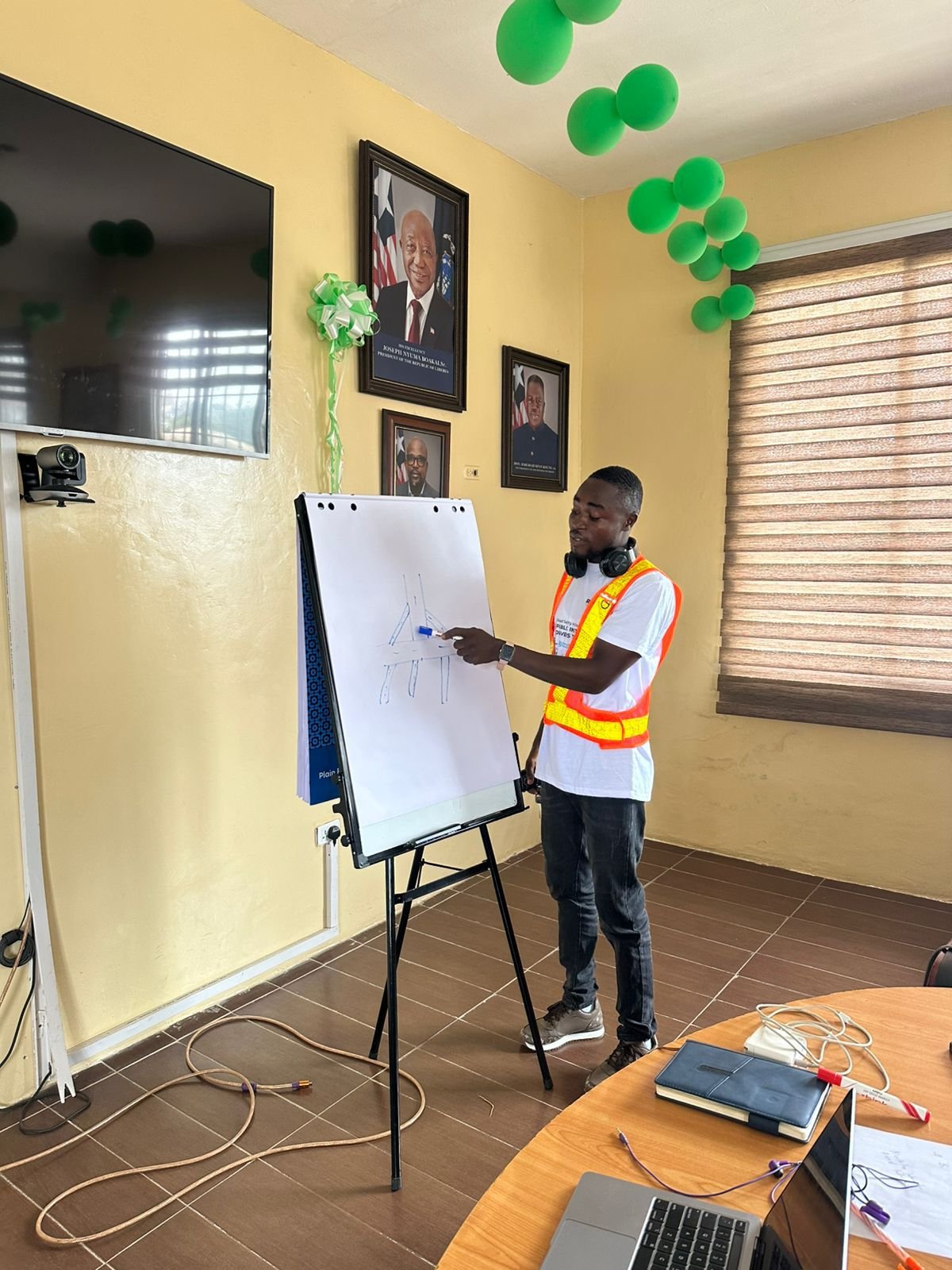
Over a three-day workshop, each participating driver is taken through five areas:
-
Road traffic law
Liberia's road traffic laws and enforcement standards.
-
Vehicle inspection and maintenance
Inspection routines and maintenance protocols for government vehicles.
-
Defensive driving
Defensive driving techniques, especially for urban and rural terrain.
-
Emergency response
First aid, emergency response and crash scene management.
-
Ethical conduct
Professional ethics and standards for interacting with the public.


The sessions are interactive, scenario-based and hands-on, so drivers apply what they learn rather than just absorbing it. Simulated crash responses, practical demonstrations and real-world case studies keep the program engaging.
Measurable results, tangible impact
After the pilot phase, ministries reported
- A noticeable decline in reckless driving behaviors
- Greater care for government vehicles
- Improved driver confidence and public trust
- More organized fleet management and reporting
In many ways, the PID Training is not just a safety program. It is a cultural shift for Liberia's public sector.
Looking ahead: 1,000+ drivers, one national roadmap
Phase II targets
- 1,000+public institution drivers
- 18government ministries
- 2 a monthinstitutions trained, June to December 2025
Building on the momentum of the pilot phase, RSAI set out to train over 1,000 public institution drivers across all 18 ministries of the Liberian government. The aim is to build an institutional model for transport safety that aligns with national development priorities, including the ARREST Agenda for Inclusive Development, the Liberia National Road Safety Action Plan (2018–2028), and global commitments under the UN Decade of Action for Road Safety (2021–2030).
Safer trips, better public services

What sets RSAI apart is not just its technical expertise but its mission-driven resolve. The PID Project is about safer drivers, and also about safer missions, more effective governance and restored public confidence. Whether it is a Ministry of Health driver rushing vaccines to a clinic, or a Gender Ministry vehicle taking social workers to a protection case, every trip taken safely is a service delivered well.
RSAI is calling on government leaders, donors, development partners and civil society to support the expansion of the PID Project. Road safety is not a sectoral concern; it is a national imperative.
Safe roads begin with informed drivers, and when public institutions lead by example, the whole nation follows.